Why Corporate Doesn’t Get It – Diversity and Marketing

Marketing and advertising execs seem to get it wrong sometimes, missing the point that diversity in one’s market is an important consideration, and you ask yourself, “Did they really think this ad was cool when they wrapped?”

Can Banks be Social?

HSBC looks to launch a social networking customer interface to raise awareness and increase engagement. Good move?

Social Media Pre-Nups and the Question of Social Media Ownership

Recent cases have raised important questions about who really owns social media assets and what steps should be taken to protect these assets.

The Evolution of Evaluation…or is it?

PR Evaluation is often overlooked in both theory and practice. Now with social media, have we evolved in the way we measure PR strategies?

PR in the City: Dismantling the Fluffy PR Model

The media has perpetuated the myth that PR is a glamorous, jetset, diva-type calling. Myth or reality?

Showing posts with label social media. Show all posts

Tuesday, 7 February 2012

Social Media Crib Sheet

Too funny not to share. A great crib sheet for the social media virgins. But all jokes aside, some people may REALLY find this useful. I think I am going to print it and share it at the office.

Pinterest – Playing with the Big Boys… and Winning

Pinterest fever -
Photo credit: Pinterest
I resisted Pinterest initially as I thought it was pointless. Then I started using it and realised it was a great concept. Here it was, I could not only bookmark “stuff” but I could also bookmark my blog and drive traffic to it. I was a pinner!

A new study from content-sharing firm Shareaholic has revealed that the social sharing platform Pinterest, which was established less than two years ago, is now the fastest-growing site for referral traffic - (read more...)
Brands can definitely explore the thousands of possibilities from the ability of customers to pin products or content that they like or want, and have their pins, re-pinned, liked and shared across multiple networks.  I will, of course, keep on pinning! Are you pinning yet? And…is your brand pin-worthy?

Sunday, 5 February 2012

Avoiding the Employee Engagement Rubber Rat!

The boring staff meeting

This article about employee town hall meetings where sitting was banned is great. On first reading that line, one might say – what a horrible organisation. However upon closer inspection, you realise that it is not as mean as it may sound.

How often have you been dragged away from your desk and from the productivity the C-Suite keep harping on, to sit in a meeting that drags on for hours? While I am all for engagement and especially where leadership is concerned, some meetings – and note I say, SOME – do not use time effectively, nor do they add value. They simply run the risk of aggravating the audience and in their minds, “wasting time”.

Engagement is important but it should also be effective. Many of us work in a fast-paced environment, and increasingly, our lives shape the way in which we communicate. We now communicate in a world of 140 characters, status updates, and short and succinct videos. Conversations do not always have to be epic. The best messages can get lost in the mire of sluggish corporate speak. The challenge for internal communicators is finding the best way to convey these messages so that 1) they are well received, understood and the receiver has good recall of the message;  2) do not head into the sphere of information overload.

While the rubber rat concept may not work for your organisation, other techniques would be more relevant – be it desktop or mobile video, internal social networking platforms or simply, better structured, better managed face-to-face meetings. 

Tuesday, 29 November 2011

Caribbean Digital Expo: Crisis Communications 2.0

Caribbean Digital Expo 2011
Photo credit: Caribbean Ideas/CDX 2011

Finally, Caribbean professionals had a chance to discuss social media in their own backyard!

The Caribbean Digital Expo was hosted by Caribbean Ideas on Nov 22 in Port of Spain, Trinidad. Aimed at providing a Caribbean-centric forum for discussions around social media and other forms of digital media, the conference looked at digital media as the future of marketing and communications across the Caribbean.

While there were many examples and discussions of how brands are using social media, the panel discussion on crisis communications and social media was timely, especially as many social media proposals stall in the board room amid fears of negativity and fallout in such a wide, open and very public forum. The idea of reputational risk building and growing faster than the blink of an eye does indeed instill terror in the hearts of executives, but as with anything else in business, there has to be a strategy and a clear road map for practitioners to follow in order to manage issues and prevent or successfully defuse crises.

Thus even when pitching a social media proposal, one must be prepared to also discuss the flip side of social media – issues and crisis management. Being prepared from the get-go is the only way to meet any negative reactions or events head on.

Thus it is important to be aware of what adverse impact may affect your brand online. Alec J Rosen’s presentation was quite comprehensive in outlining the steps in managing crises online.

In order to stay ahead of the curve, scan the cybersphere, and assess the impact of social media activity on your organisation and go through the various scenarios which may impact organisational reputation online.

Preparing social media mitigation tools, both online and offline, for example a dark site for activation in the face of a crisis, an 800-number for crisis management and feedback, cross functional teams within the organization, and an ongoing cultivation of friends and allies who will prove to be exceptional brand evangelists in the turning tide.

Scanning the social media landscape for issues
and in order to manage crises
Photo credit: ActiveMetrics
Identifying the crises, whether they be sudden crises, or slow to develop crises is also important.

The response, whereby there are not only regular updates but conversations. Thus meetings with the crisis team and internet searches. The importance of being searchable will prove to be very important during a crisis, in order to monitor what is being said, where and by whom.  This is when you can activate one’s crisis management plan, and I love how Judette Coward-Puglisi of Mango MediaCaribbean, mentioned “holding tweets” in addition to the more traditional holding statements. Traditional crisis response tools such as press releases can and should be augmented by tweets, Facebook updates and I would suggest as well well-crafted video responses. Having a clear online response balances the negative reactions which will ultimately live online.

Rosen also pointed out that communication must be proactive. It must be open, it must reach and influence the various audiences, it must be multi-channel, and of course, it must be factual and clearly on message.

And of course, the E word that everyone loves to hate but which is so important in every aspect of communications – evaluation.  One must evaluate the outcomes and review key learnings which will influence the crisis management plan going forward.

This was the most useful part of the expo for me. Much of it also seemed to indicate that organisations still think social media is a "nice thing to have" as a lot of the questions/comments seemed to suggest. But great start!

Tuesday, 15 November 2011

Can Banks be Social?

HSBC as part of the skyline - China
I read an article yesterday about global financial services provider, HSBC's plans to implement a Facebook-type interface for customers.


...Britain's biggest bank is planning to create a new online platform catering for customers' non-financial needs. One industry source said: 'They want to set up their own version of Facebook.' - PR Week


Is this a step in the right direction? Financial services is one of those sectors which still have not really "gotten" social media. A lot of this has to do with the nature of the industry, which is highly regulated. During one discussion I had with a PR executive in a FTSE-100 listed financial services organisation, this was clear:


We’re not quite sure what we can do with these parameters cause as a company selling financial products, you can’t be seen as giving advice and therefore, there is a fine line. If we’re responding to somebody, are we advising them or are we just giving them information? 

In the case of HSBC, they are avoiding this proverbial fine line and hoping to use this interface for non-financial services and information, which they hope will differentiate them from their competitors.


‘Moving away from direct sales, we will build a distinct digital offering centred on customer’s future needs financial and non-financial. We will simply ask our customers to share their needs, and we will then feedback where possible to help people fulfil them [...]The social media strategy will be instrumental in not only raising awareness, but also in building the primary platform(s) for which customers will engage with the campaign. It will attract new customers while further engaging existing ones. - PR Week

HSBC is looking for agency support for this strategy at the moment, but is there any hope for success? If the company is looking to engage customers outside the parameters of what financial companies can and cannot communicate vis a vis industry regulations, then it is a good start. However, as the author of the article commented


The odds are certainly against it. There is very little historical evidence for any consumer appetite to mix financial and social activity. The dynamics of the relationship between banks and their customers are almost entirely functional and based on rational criteria.

Having had the experience in trying to mix financial and social activity for a customer base, I agree it is often challenging but certainly not impossible. Relationships do not have to be strictly "functional" or based on the necessary logistics. Customer engagement is just as important in such an area as in any other, especially when it comes to developing the overall face and brand of the organisation. And as the brief says, the company wants to gauge customers' needs. One cannot assume that they don't have other needs besides dollars and cents. Who knows what they may want! The jump off point may be a bit ambitious - a whole new interface built from scratch - but the rationale is indeed commendable.

Monday, 14 November 2011

Social Media Pre-Nups and the Question of Social Media Ownership

Are brand-associated social media channels
trade secrets?

I have been following with great interest the debate about who owns social media followers. First, we have the case of Laura Kuenssberg who left her job as chief political correspondent at the BBC and moved on to rival, ITV on its business desk, taking over 60,000 Twitter followers with her. And it was as simple as changing her Twitter name and moving from @BBCLauraK to @ITVLauraK.

And most recently, there is the case of PhoneDog versus NoahKravitz in a battle to the death over 17,000 Twitter followers that the company asserts were “stolen” from them, when Kravitz, upon leaving the company, changed his screen name from @PhoneDog_Noah to @noahkravitz.

One may argue that the question is who has ownership of your voice but it is also a wider issue of how one chooses to brand oneself within the social media space and how this ultimately affects the entire question of who owns what.

Both Kuenssberg and Kravitz built massive Twitter followings using their employers’ names as an extension of their brand. And while social media is about humanising a brand and having real people, with their own tone, passion and je ne sais quoi, one also has to question whether most followers are subscribing to the person or to the brand. 

@ITVLauraK - Laura Kuenssberg's Twitter page
In Kuenssberg’s case, were followers really that interested in business news from ITV or did they specifically follow her because she “represented” BBC’s politics desk? There is a very murky grey area around the whole issue and one that many organisations may now wish to address in a more formal way.

When leaving a job, you are obliged to relinquish tangible and intangible ownership of perks to the position – personal computers, mobile phones, vehicles, representation. Now one also has to consider the protection of social media capital. Is a Twitter password, really a “trade secret”? If the company’s brand is clearly stated and it is not just an employee lending professional opinion from a personal account, what steps should be taken? The Drum cites the opinion of attorney, Steve Kuncewicz:

“… the best thing for a business would be to include a clause in their employment contracts requiring that anyone who tweets on their behalf should do so using a username that incorporates a brand (as ITV and PhoneDog did) - this way they can look to take action under Twitter's terms of use to force that user to close down the account for the unauthorised use of or suggestion of a continuing connection with that brand when they leave. Trying to work in any kind of clause which confers ownership of the existing following of a high-profile employee joining the business will be difficult if not impossible, so starting as you mean to go on is the best way of keeping hold of followers in this kind of situation, along with including a clause which prohibits the employee from making an announcement on their work-profile that they're leaving in an effort to move followers to their new account.”

So, while subscribers ultimately have a choice between the person and the brand, it still comes back to the need for brands to have a clear and strong social media policy – a social media pre-nup, as it were – about, among other things, who gets the “assets” when the marriage is over.

Friday, 11 November 2011

Caribbean Digital Expo

My first post since I gave the blog a much needed overhaul! It's like Christmas over here!

So having just finished a year-long tour of duty as a postgrad student/expat in London, I am excited to be heading back to work soon. And I will be hitting the ground running. There are many exciting plans ahead and excited people make me excited as well. To sweeten the pot, I was silently hoping my boss and I shared the same vision and passion, and he would surprise me by signing us up for the Caribbean Digital Expo which would be on the second day of my new job. I came home and heard all the buzz around it and wondered how I would make it work.

Gold star to my boss! I will be there and I am excited that such a conference is finally taking place in Trinidad and Tobago. With speakers from amazing organisations such as Facebook and RIM/Blackberry, as well as case studies from local companies, it should be a fantastic day of networking, exchanging of ideas and experiences and brainstorming.

Here is my former boss, who will be one of the presenters, and who also was as excited about digital in our last roles, as my new boss. Like Danielle, I don't think any part of my life is un-social. Business has to not transform people, but it is clear that people and technology have also transformed the way we do business!

Thank God for progress! 

Wednesday, 2 November 2011

A is for Apple (Not the Fruit)

Earlier this year, I read an article about a recent study that showed kids between the ages of 2-5 are more likley to be skilled in in the ins and outs of a smartphone, than they are with the ins and outs of tying their shoes, which in past generations was a learning/development milestone.  So when I saw this image this morning, I chuckled. Signs of the times!! How ancient our childhood joys must now seem!

The 2011 method for teaching kids their ABCs?

Friday, 1 July 2011

The Evolution of Evaluation...or is it?

On 21 April 2007, GlaxoSmithKline started a communications revolution when the pharmaceutical giant became the first company listed on the FTSE 100 share index to send a tweet.

Eight months later, on 5 December 2007, Carnival Cruises set sail on its Facebook adventure, becoming the first FTSE 100 company to establish a presence on the social networking site.

Today, 67 members of the FTSE 100 index are actively engaged in social media. 

three [d] Digital and Social Media, www.threepipe.co.uk

edit: *I spoke to the Digital Communications Manager at GSK who indicated that from "a corporate standpoint, GSK was not the first FTSE 100 company to tweet back in 2007, as we did not own any Twitter accounts then."


In an earlier blog entry, I decided that PR evaluation is often overlooked in theory and in practice and thus came my topic for my Master's dissertation. Organisations are using public relations (PR) as part of their “problem solving and change processes” (Broom, 2009, p. 285), and while many practitioners are implementing a myriad of campaigns by which to do this, there is still widespread debate about PR, and its effectiveness and value from a business perspective.

Amidst the continuing debate about the evaluation of PR, the rise of new media technologies, notably social media, offers a new challenge to PR practitioners as it relates to evaluation. Many trade associations such as the CIPR, the International Association of Business Communicators (IABC), the Public Relations Society of America (PRSA) and the Association of Measurement and Evaluation for Communication (AMEC) have consistently been asking the question, “How do you get started in measuring social media and what are the relevant metrics?” (CIPR, 2011).

My study will explore what PR practitioners across the FTSE 100 companies expect to achieve by integrating social media into their ongoing programmes and campaigns, and more importantly, how well they evaluate these objectives and what are the prevailing metrics, methods and tools used across the industry.


I have already had the opportunity to interview a few PR practitioners from large UK companies and gained some fantastic insight from them. 

----
References cited:
  • Broom, G.M. (2009) Cutlip & Center’s Effective Public Relations, 10th edn. New Jersey: Pearson Education Inc
  • CIPR (2011) Social Media Measurement Guidance. Available at: http://www.cipr.co.uk/sites/default/files/Final_Social_Media_Measurement_Guidance%20_March_2011.pdf (Accessed: 2 April, 2011) 

Wednesday, 30 March 2011

How Do You Measure PR?

PR Measurement is critical and not an option!
I have found recently that in doing assignments, with limited word counts, that one of the shortest sections, if not the shortest section is usually the Evaluation and Measurement section. Much goes into the strategy and tactics sections, with details going into the appendices, but the poor Evaluation section suffers.

In real life, it shouldn't and it is the reason I have decided to look at PR measurement, specifically social media in PR measurement for my dissertation. Evaluation is nothing new, but with all the buzz about social media, all the hype and gloss, many people are interested in the question - how do we measure this thing? I am interested in it.

Advertising Value Equivalents (AVEs)
have no place in PR measurement
There are still so many nebulous areas where measurement is concerned and not enough standardisation. PR Week recently announced it would not considering AVEs as a measurement criteria for its annual awards. The Association for Measurement and Evaluation of Communication (AMEC) has also been steadily campaigning to do away with the AVE as a standard for PR measurement.

Evaluation and measurement of PR is nothing new, so why has the PR industry taken so long to make its own mark on evaluating what it does, rather than using metrics from other disciplines as a benchmark? And like my assignments, why do we shy away from research and evaluation, while paying a great deal of attention to tactics? I would think that one would lead to the other and to the other - A to B to C.

And now with social media, which may still come across as fluffy stuff to some senior executives, that we have now really been focusing on proving its value and showing how it can be evaluated, the whole question of measurement of PR in general seems even more critical. The Barcelona Declaration of Research Principles was released in June 2010, and for the PR industry, it is a good first step:


  1. Goal setting and measurement are fundamental aspects of any PR programme
  2. Measuring the effect on outcomes is preferred to measuring outputs
  3. The effect on business results can and should be measured where possible
  4. Media measurement requires quality and quantity
  5. AVEs are not the value of PR
  6. Social media can and should be measured
  7. Transparency and replicability are paramount to sound measurement.


So it is in honour of my abbreviated evaluation sections over the past few months, and out of a genuine interest to see what my peers are doing in real business cases, that I will be pounding the library and the doors of industry to find out, what are we doing, how are we doing it in terms of PR/social media measurement.

Saturday, 12 February 2011

Lights. Camera. Fashion. And the evolution of media relations

Photo credit: AP Photo/Andrew Burton via Yahoo News
Hair. Makeup. Couture.
Press. Publicists. Bloggers.

New York Fashion Week is on and what I love about this is how the media landscape has changed from a few years ago to what it is now. Social media has changed the face of media relations across the PR industry. Gone are the days when having a by-line in a newspaper made you the most important dude to a PR exec. Now with a laptop and an opinion, you can catch the attention of PR teams, whose eyes now have to scan new forms of media to gauge opinions about their brands and to build their brands.

Photo credit: Reuters/Eric Thayer via Yahoo News
I love that Tumblr has sent 24 of its fashion bloggers to NYFW. Just regular people with a love for fashion, who have a great following and who have the power to influence their readers.Great strategy for Tumblr, which is a favourite platform for photogs and fashionistas.  One of their Tumblrs is only 16 years old - from Devon, England. She will be rubbing shoulders with Oscar de la Renta and top fashion editors, and "reporting" live from one of the premier fashion events in the world. A 16 year old can open up the world of high fashion to an audience that may yet be untapped by traditional media. It's pretty damn awesome.

Media ownership now goes way beyond conglomerates. It lies in the keyboards of the citizens of the world. Media relations strategies now have to include and consider social media influencers in promoting the personality and image of the brand - making brands so much more accessible to so many more people. It's really fantastic how quickly things have changed.

I regularly follow one of the 24 Tumblrs - Jessica Quirke - and she is having a remarkable experience. She and the 54,000 people who follow her religiously. Amazing.

Wednesday, 9 February 2011

Valentine's Day - 2011 style

I found this great video by the always great Socialnomics, and it was too cute not to share.


Also a rewind to the past.

Sunday, 9 January 2011

Return of a PR Superstar

I must first apologise to everyone for being such a bad host. I have been beyond busy and the blog was a victim of my new life.

But I promised that 2011 would see me doing much better so please accept my apologies and give me another chance!

I guess I should tell you that I am now a full time Masters student in London - in what else? Communications (with a lot of Marketing as well). I have been here since September - hence the date of the last post. It has been a maddening pace. Maddening. The transition from corporate lush to library-beating student was not that traumatic - mainly because I was not a corporate lush. Part of any good employee's job function should be to constantly stay in the loop with the latest trends and developments in their field. This blog allowed me to explore some of these trends and to meet people who allowed me to see what they were doing in their roles, in their countries. So getting into a formal setting where we were being taught about what's happening - not that much of a stretch.

I have been learning a lot and often, contributed much more. Having job experience - and not just summer job experience - but considerable and hefty real-life corporate experience, has made this even more illuminating, because you can start applying stuff in your mind to real life experiences.

It's almost dissertation time and I am leaning towards a dissertation on sponsorship, but being the social media maven that I am, I want to maybe look at it from that angle. Suggestions?

My 2011 resolution is to be a better communications blogger. That sentence in itself is a bit of a contradiction. By way of being a communicator, this should be a non-issue. But sometimes life just gets in the way. I hope to see you guys more often this time around.

Happy New Year and welcome back to me!

Monday, 12 July 2010

This Time for Africa

One month, 64 games and 145 goals later, the world's biggest event is over. Dry those eyes and pack away those vuvuzelas because you have to wait another 4 years until the next one. But what a World Cup it has been. I think this tournament will be one that will be remembered for years, for a variety of reasons - footballing and non-footballing reasons.

But I think as the sun goes down on this World Cup, South Africa can be duly proud of what they have achieved as host and as a country. The hosting of this tournament for not just South Africa, but the entire continent of Africa has been a marketing and rebranding coup. Two years ago, FIFA President Sepp Blatter said
“People don’t want to trust Africa. That is wrong. Africa has given so much not only to football but to the whole world. Someday, something should come back. So let’s have this World Cup. Let’s celebrate Africa. Why not?”

And celebrate we all did. Even though popularised by a Colombian singer, the strains of "Waka Waka" and its tag line "This Time for Africa", continue to filter through the airwaves, leaving it as probably one of the most popular tournament anthems ever.The world has looked to South Africa over the past month for great football, but got more than they bargained for in the artistry, passion, energy and dare I say, unity of its people.
This game allowed Africa to showcase its beauty and the remnants of Apartheid regime, to the outside world, which seems to have no idea how bad things were and that there is a better side of Africa(beside tribal wars and starvation) which international media—for its own convenience ---tends not to focus on. - Ghanaweb

Whether the powers that be will leap on the momentum which this World Cup has generated and leverage all the positives into effecting socio-economic change is another story, but well done South Africa.

And without a doubt, this tournament's immense public appeal and attraction was heavily invested in the fact that we had greater means to communicate, participate and enjoy the tournament's various facets. World Cup 2010 was supposed to be the social media World Cup and boy was it ever. Information, debates, opinions, replays - all available at the click of a button, whether it be on Twitter, Facebook, Youtube, the obsessed and the curious all found a way to be part of this global phenomenon via this global phenomenon. Sponsors and pundits alike milked it for all it was worth, tapping into the enormous audience primed to receive messages.

Twitter reported that the World Cup or #Worldcup resulted in a record 3,283 tweets per second as opposed to the regular average of 750 per second. The fail whale was almost as recognisable as Paul the Octopus, because of the barrage of tweets around the tournament. Social media has truly revolutionised the way we love the game, and the way the host country was marketed to the millions who could not make it there to see the games live.

At the end of it all, though Spain were crowned the best team in the world, the real winners were South Africa and social media, and all the people who joined the revolution to make this one of the best tournaments the world has ever seen.  Brazil 2014 has some rather big shoes to fill, but I think they can do it. In 4 years, this phenomenon may be bigger than any of us can ever have imagined.

Runners up: Paul and the vuvuzelas.

Tuesday, 22 June 2010

Licence to Kill. Licence to Tweet.


Even with the football fever gripping my senses, I am still aware that the world is not a giant football revolving around the sun.

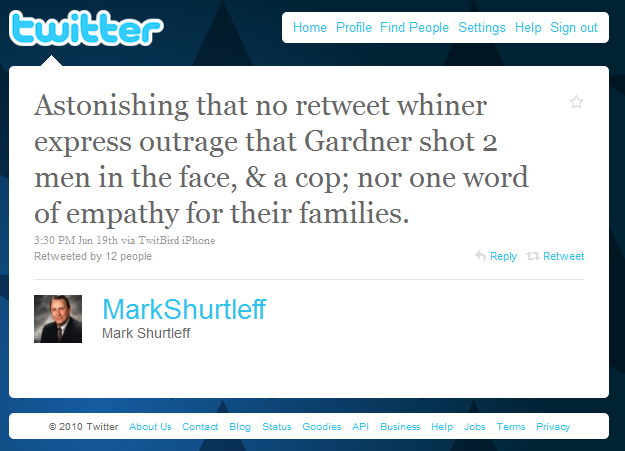
The news headline on BBC news that morning was "Utah executes convicted murderer by Firing Squad". I have a host of other issues with this story but one of the most talked about aspects of it is definitely the tweet heard around the world.


Many people felt the tweeting of the death of a man, albeit a cold blooded, clearly sadistic murderer, to be grotesque at best and inappropriate. Mr Shurtleff says he believes in an informed public and he continues to "use social media to communicate directly with people".

I do agree with him there. Social media has changed the way we communicate and can really bring us closer to our various publics. But even though I am an advocate for social media, I always contend that sometimes we get so caught up in the hype that we forget the basics. I did not think Twitter was the best place to tweet about this and maybe that is my own moral perspective. But I also don't think Mr Shurtleff should be left to his own devices with Twitter. I really believe he needs a Twitter intervention because looking at this single tweet in a vacuum does not begin to demonstrate the fact that Twitter is a powerful PR tool, which in 140 characters can make or break one's image.

I was a bit taken aback by the lack of tact here. It's almost like he could not wait for the guy to be pronounced dead so he could have his 5 minutes of fame.


The AG would do well to think before he tweets, especially considering the very public office he holds, for while verbal comments may not always be picked up, tweets are forever. Yes, you may want to publicly defend your stance on "death by tweet" but berating your followers? Really?


And calling them whiners? Who is this dude's media adviser? Someone needs to hide his laptop and his smartphone!!!


I am after all this, slightly amused by his Twitteritis, and sincerely hope he gets help. And while we use social media for communicating news and important messages, as with everything else, some messages may require different vehicles for safe passage. There are also issues of what is and isn't appropriate for social media and these are questions that many of us may have to consider in the future. I mean, you never know what may be next!


Monday, 24 May 2010

Election 2010: Cyber Police

I have been observing what's been happening on the cybersphere for the past few hours. I posed this question to a colleague last week and I still do not have the answer, but the question relates to the excerpt below:
I am advising the public that they are to seek information on what they can and cannot do on election day and ensure that the law is adhered to,” (Ag. CoP) Philbert said, adding that absolutely no campaigning will be allowed next Monday and his officers will be out in full force to ensure breaches will be detected and met with the full brunt of the law. - Newsday

I consciously chose my shirt today based on what I have always known as a very serious legal issue - campaigning on election day. Be it on the streets, or via the media, it has been a no-no for as long as I can remember. Though I was not totally certain whether it is indeed a transgression, I did not want to somehow be barred from voting because I wore a party colour. However, is anyone policing social media, because from where I sit, I have seen some questionable things. And if the parties have used social media to campaign all throughout the campaign, then in my view, doing it today is just as illegal as doing it via traditional means. I saw one newspaper place a disclaimer saying it would delete any comment which went down this road, and that is indeed commendable. But while the TTPS are out in the 41 constituences to prevent this from happening today (in addition to cracking down on election bootleg alcoholic drinks) who is policing the web today? It may be new - this whole social media thing and how it impacts our elections and our laws - but it's worth clarifying.

Friday, 21 May 2010

Friday Fun: Must-Tweet TV


Like all social activities, television-watching demands compromise. People may have strong ideas about what they want to watch, but what they really want to do is watch together. - The Economist

I am a huge Grey's fan. So are my friends. We don't get to watch it together. But we watch it together. Chirping Blackberry phones, FB status updates and comments, tweets. The experience of watching tv with friends all across the country and around the world has the ability to create an almost cult-like experience, in real time and in post-time. You can collectively cheer, gnash teeth and cry because you're connected and it no longer is a solitary experience with you and your ice cream. It's that whole communal element that made tv so popular in the first place.

NBC recently revealed its new social initiative on its MyNBC platform. ABC, which is the network which created Grey's Anatomy needs to get us on board!!! Ah. No need to get off the couch and go anywhere. And though we don't get Hulu videos here, the idea of social tv is one which works for this generation of social networkers who love tv and who live for exciting season finales. I thoroughly enjoy sharing my fave shows with friends who feel the exact same way about the show, because it's not the same when your husband or boyfriend is forced to watch it with you because of blackmail. It's just not the same.

Does the lean-forward expe­ri­ence, inter­ac­tiv­ity and backchan­nel chat­ter of social net­works have a place in the tightly con­trolled, lean-back world of tele­vi­sion? - JD Lasica

The answer is a resounding yes!

Thursday, 20 May 2010

Real Case: Perils of Small Business BEING Online

Now we all understand the importance of customer service and the importance of customer service training for staff. Customer service is usually one of the tenets of a strong brand and it has the power to set the brand apart from its competitors. I have had my fair share of excellent customer service and horrendous customer service here in Trinidad and Tobago. One bad example was when a waitress used the F-bomb to vent her frustration when SHE messed up my friend's order and she felt she needed to tell me I was F-ing confused. I did not bother to order anything after that. I did go to the manager and tell him about the encounter and his response, or lack thereof was alarming to say the least. In fact I think he was drunk.

Now yesterday I shared my opinion on why small businesses should be online. But while we do create a website or a Page or a Twitter channel, we cannot forget that how we interact with our online communities also constitues as customer service. Social media channels such as company Twitter pages and Facebook Pages allow brands to not only promote their brand, but they also use it as a conduit to deliver assistance to their customers.

In larger organisations, the communications and promotion either lies with a marketing or communications team or individual as the case may be, who usually have the skills to properly manage feedback and concerns. In the small business scenario, this is not always the case and it may be the owner or an employee. Here is an example of a social media admin gone wrong.

While service browsing recently, I came upon a Facebook Page for one fitness provider, where the customers were miffed about an unexpected and immediate price increase for membership. This was the first response from "management". I am posting it as I found it.
well we didnt even no until the day it was raised, but come on its only by $50.00 come on. its still a good rate and plus all d classes r for free, where else u gettin dat?...please, ok. where u gettin dat? yes we shld of let eveyone know in advance...but it has been done already
Shock does not begin to explain it. Of course subsequent customer responses were not conciliatory. The second response, from the second admin was:
I understand your dismay with the sudden change of membership rates. I apologise for this.  We take note of your suggestion for more notification and will bear this in mind for future operational/organizational changes that will affect our members. The rates for the first quarter were an introductory rate as is customary for all new goods and services in a developed and competitive market. However, you will notice that with the increase in rates, we have also increased the number and availabilty of classes, the increase in the floor space as well as the continuing increase of equipment and machinery. So while you may not benefit from class participation, there is and will be more and a wider variety of equiment available for your use. Again I do apologise for any issues that may have arose due the change of rates, but we do hope you continue to support (company name)
1. Customer service goes beyond frontline staff. It applies to everyone, in every department, across all functions and via all media, be it in a physical setting or virtually. Clearly the second response was a more measured and professional response, balancing the apology for the price increase with the benefits which the increase brought with it. I can appreciate that response more than the combative, not to mention, linguistically challenged reply up top. The danger they faced was that customers could have taken this poor customer service to the masses with the click of a mouse.

2. I am becoming more and more convinced that some organisations still view social media as "something else we can do" and not as a real, and powerful marketing tool. I swear, between this and some of the other local social media sites I have observed, it's almost as if they just asked the office boy if he had a Facebook acocunt and told him run with it. Social media just cannot be taken for granted and if you're going to be using it for your small business, then don't short change yourself.
  • Learn about the tools.
  • Invest in training your staff to use them effetcively and in a way that builds, not destroys your brand
  • Value the tools and what they can do for your business.
It is vital to hire, train, and monitor customer service employees. Each must understand what the brand is about, why their interactions with consumers are important, and what is expected of them - Augie Ray

And if your brand is now on the social media path, the same applies and is more important than ever!

Wednesday, 19 May 2010

The Perils of Keeping your Small Business Offline

Yesterday I tweeted this question:

So, is it?

I was actually trying to find a caterer for an event I am planning, preferably one closer to the event, and it has been an ordeal. Clearly a lot of small businesses are not online and this is worrying. I had to eventually resort to emailing friends for recommendations or suggestions and ended up calling a few of the options. Quite frankly, I find this tedious. I am online most of the time, so it is easier, not to mention more convenient to do a quick Google search, locate a website and then email the person. Or at least the website would have enough preliminary information that when and if I do call, I am not in a state of utter ignorance and I am a bit more informed and persuaded to make a positive consumer decision.
There are a lot of small businesses out there and I applaud this. I think it is great when people follow their passions and make their dreams of having their own business a reality. But really...gone are the days when you printed flyers on coloured paper and left them on office coffee tables and on lightposts. Why don't you have an email address for your business? This is not at all a winning move!
When I called the caterer that sounded the most promising, she asked me for my email "number"...wow. Then when I finally got the email, it was from her friend's email address because she did not have an email address, and the friend's address was sketchy at best (something along the lines of sweetreds@domain.com). A total fail.

Funding agencies for entrepreneurs should be equipped to assist small business owners with the information on these basics and why they are so important. While a start-up may not be able to afford a snazzy website off the bat, Facebook Pages have now made it easier to get yourself an online presence. Too easy. Way too easy. So, why aren't you online, and why should you be?

The internet is like the Yellow Pages - I only use the physical yellow pages when I am on the road and cannot get through to the operator. For everything else, I turn to Google. Millions of people feel the same way, so if you're not online, you're almost non-existent.
Visibility, credibility and promotion - It's all well and good to have people know you via a friend, but you can really establish your new brand with an online presence, which can take you from the lightpost to the masses with a couple easy steps and great content. For my caterer friend, if your menus are online, I don't have to wait for your friend to email them to me, or worse...fax them and hope it's a good copy.

Online orders/online business - There are those who have not seen a physical cash register in years because they live by online shopping/ordering. Don't limit yourself and lose the opportunity to bring in some extra business.

Analytics/Feedback/customer suggestions - How many people are visiting your site? Who are they? Where are they? This kind of information can help you market your business and develop new ideas to meet the needs of the people who have shown an interest in what you're selling. Additionally, you can get a lot of great feedback from customers which can assist you in fine tuning your products/services.
Not because you're operating out of your kitchen, should it mean that your marketing efforts should fall by the wayside. It's more important in the start up phase to establish yourself and get your business name, your services, your contact info etc out there to prospective customers. Your online presence is part of your calling card - it gives you greater legitimacy and greater visibility. And please...

  • Have an email address that identifies your company - sweetreds@domain.com is not it. Use your company name to identify yourself electronically.
  • Ensure your site, your Page and your website, are professional and cover the areas that a prospective customer may be interested in.
I am left holding a copy of a menu that leaves me a bit cold, and will have to now call her back and make suggestions. That is, if she answers the phone, because on my first attempt she had forgotten her phone at her aunt's house and the aunt had to take a message and have her call me back a couple hours later. If there was an option, where the business was already online, with a more convenient communication channel, then she would surely miss out on my event and my business. Don't make the same mistake.

Photo credit: www.freewebsitetemplates.com

Tuesday, 18 May 2010

Zeroing in, or out...on your brand

When Twitter zero'ed out last week, lots of faces crumpled in anguish, in sheer terror because the legions of followers they had built up over the past few weeks, past several months were suddenly gone, leaving them in an empty room, with no voices, no chatter, no hero worship. Among these were the brands who had painstakingly set up fancy Twitter pages, all nicely branded and boiler-plated. Luckily for all of them...us...it was a temporary glitch and in no time at all, the world had righted itself and following and followers had been restored.

But what if it hadn't? What if Twitter had screwed up your online "popularity" forever? What if you had lost all your followers - all those people who reached out to you during the day asking questions, retweeting your links, #FF-ing you? Would you have survived?

And more importantly for brands, do you have any idea who these people are? Now chances of knowing them all, may be slim to none. But is the rapport with them strong enough to withstand a crash such as this, and make them come back on their own, without you having to sit at your desk, trying to remember their Twitter handles?

It's something to think about isn't it? One lesson brands can learn from this is to not put all their social media energies into one social media basket. Some folks love Twitter and that's the extent of the relationship, but as we saw last week, it can be doom for the one-way brand. It's not an excuse to now go out and populate the SM universe. Be practical and relevant and go where your audience is sure to be. Be practical if you're a one-man show and it's just you managing social media.

But the other question coming out of the Great Zero is...

Would you have been able to keep on going without them?

There are some who have relied so heavily on social media that perhaps the traditional forms of engagement and communication have taken a bit of a hit. So on a day when the technology hits the skids, are you prepared to keep it going without missing a beat? Have you managed to create a synergy with your online tools and your traditional strategies to build a loyal offline community?

I often wonder where I would be if one day I lost my old phone (not a smartphone, so I guess it's a dumbphone), chock full of email addresses, phone numbers and texts with important info - all of which, sadly, is saved nowhere else. I think about a life before advanced mobile technology and how my telephone book was just that - an actual book, and I could rattle off numbers without blinking because I did not have mobile phone books to depend on. Now, with maybe the exception of my mother's mobile number and those of a couple close friends, I am just terrible with remembering data like that now. At the same time however, I am not limited by emails and tweets when it comes to my real life relationships. It makes it more fun, more convenient, yes...but it does not beat going out in the real world.

So really the question is How else are you building your brand?

  • Is your website a hot mess because you have sold your soul to Facebook and Twitter?
  • Do your followers know how else to find you, i.e. via your website or other platform, or do they think your Twitter URL is your...well...your URL?
  • Is your non-virtual frontline customer service below par because you are a Twitter customer service superstar?
  • Have you done away with in-depth articles or blogs because you've got 140 characters?

It seems ludicrous but it's a serious question - one which we all should be asking ourselves because at the end of the day, these are merely tools and not the whole enchilada. If the basket of eggs should fall, would that be the end for your strategy?

Twitter Delicious Facebook Digg Stumbleupon Favorites More